Treatment
Root Canal Treatment in Mesa, AZ
A tooth has started hurting, someone has said the words root canal, and you'd rather it were anything else.
The treatment removes the cause of that pain and keeps the tooth in your mouth, and it's carried out under local anesthetic in the same way a filling is.
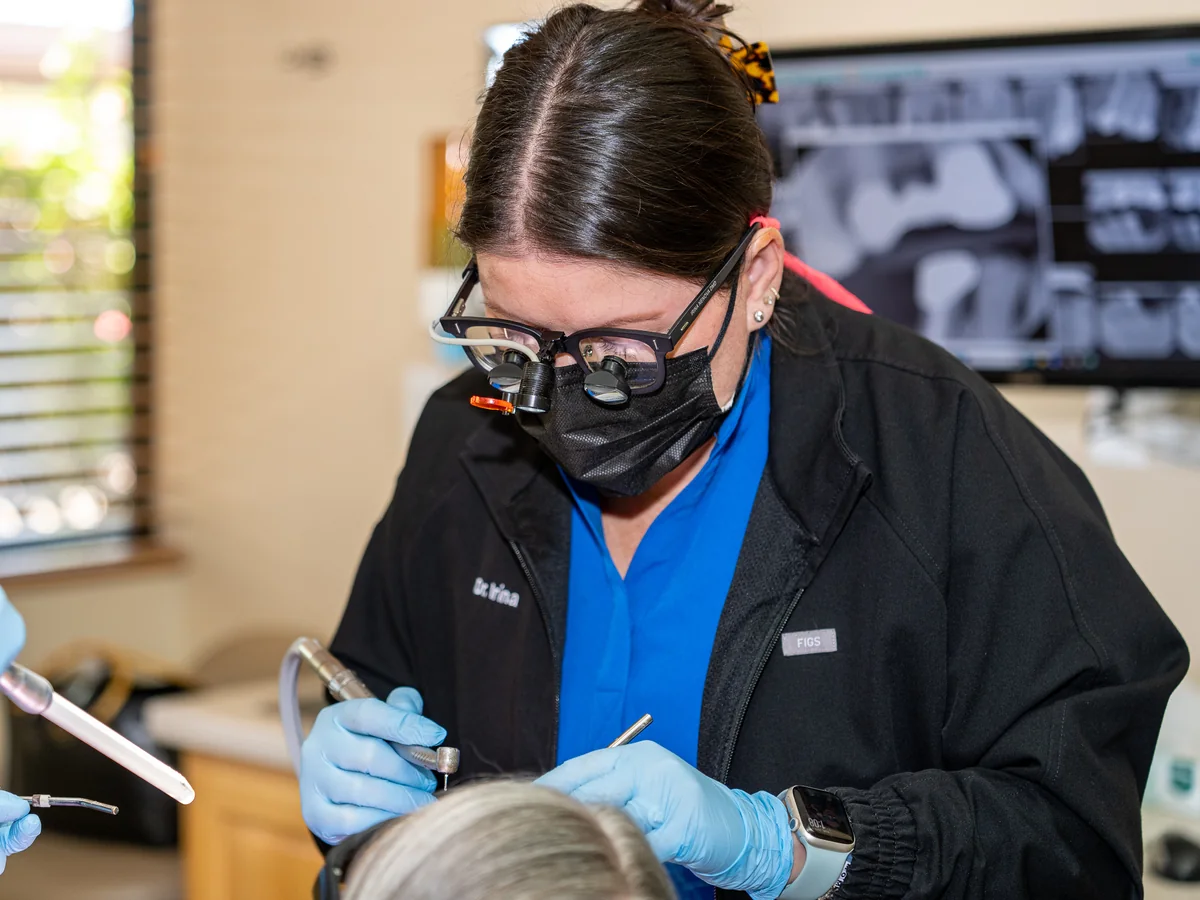
The treatment
What's actually happening inside the tooth
Under the hard outer layers of every tooth there's a soft core, called the pulp, carrying the nerve and the blood supply that fed the tooth while it was forming. Decay, a crack, a deep filling or a knock can let bacteria reach it. Once they do, the pulp becomes inflamed and then infected. Because it sits sealed inside a rigid chamber with nowhere to swell, the pressure has nowhere to go. That's the throb that keeps people awake.
Root canal treatment removes that tissue, cleans and shapes the narrow canals it ran down inside the roots, and seals them so bacteria can't get back in. Nothing leaves your mouth. The roots stay in the bone, and the part of the tooth you can see goes on biting and goes on showing when you smile.
Why the treatment is the thing that stops the pain
Root canals have a reputation, and it's better to say so than to talk around it. Ask most people what a root canal is and they will describe pain rather than a procedure.
That gets the order backwards. The pain people remember is very often the pain that took them to the dentist in the first place. The treatment is what removes its cause. It's carried out under local anesthetic, the same as a filling, so you shouldn't feel the work happening. If you do feel something, more anesthetic can be given. Nobody expects you to sit through it.
None of which means it's nothing. The appointment is longer than a filling and your mouth is open for more of it. A tooth that has been sore for days is often tender to bite on for a few days more. Both are worth knowing in advance, and neither is what the reputation is really about.
If you're dreading it, say so when you book rather than once you're in the chair. It changes how the appointment is paced, and it's an ordinary thing to ask for.
Why a crown usually follows on a back tooth
A root-treated molar has had material removed from the middle of it and no longer has its own blood supply. It's drier and more brittle than it was, and the cusps that do the chewing are left standing with less holding them together, so it becomes more liable to split under a heavy bite. A crown caps it and spreads that load.
A tooth that splits vertically through the root generally can't be saved, so the crown is protecting the treatment you've just had rather than being an extra sold on top of it. Front teeth take far less chewing force and can sometimes be restored with a filling alone.
Good to know
Treats the nerve inside the tooth, not the outside
Carried out under local anesthetic
The tooth stays in your mouth
Usually finished with a crown
May take one appointment or two
What to expect
Four stages, spread over a few visits.
01
We work out what's wrong
An exam, an X-ray and a few simple tests on the nerve, so we can find which tooth is responsible and whether the pulp can still recover.
02
We numb it, then clean it
We give the anesthetic time to work properly. Then we make a small opening, clean the canals with fine instruments, and rinse them out.
03
We seal the canals
We fill the cleaned canals with a rubber-like material and seal them. That's what keeps bacteria from getting back in.
04
We rebuild the tooth
A filling closes the opening. On most back teeth we'll plan a crown to follow, so the load of chewing is spread properly.
Candidacy
Is a root canal the right answer for your tooth?
It's usually worth doing when the tooth around the infected nerve is otherwise sound. It's a weaker case, and sometimes the wrong case, when there's too little left to rebuild.
Enough solid tooth above the gum to rebuild and hold a crown.
Healthy bone underneath, and a tooth you actually chew on.
Too little tooth left above the gum to hold a crown afterward.
A crack in the root itself, which the treatment can't repair.
Advanced gum disease that has already loosened the tooth.
A wisdom tooth you don't chew on, where taking it out is simpler.
Common questions
Is a root canal as bad as people say?
The reputation is older than the dentistry. What people tend to remember is the pain that sent them to the dentist in the first place, because an infected nerve is one of the sharper things a body does, and the treatment is what takes that away. The work itself is done under local anesthetic, in the same way a filling is. Expect the appointment to be longer than a filling, and expect the tooth to be tender to bite on for a few days afterward.
How do I know whether I actually need one?
The usual signs are a lingering ache, sensitivity to hot or cold that stays after the drink has gone, pain on biting, or a swelling on the gum near the tooth. None of them is proof on its own. It takes an examination, an X-ray and a couple of simple tests on the nerve to tell whether the pulp can still recover. Part of that appointment is ruling a root canal out, because not every painful tooth needs one.
The pain stopped on its own. Can I leave it?
Pain going away isn't always good news. When a nerve dies it stops sending signals, so the tooth can go quiet while the infection at the root carries on. That's why a tooth that hurt last month and doesn't hurt today is still worth looking at. Whether it needs treating now, or can reasonably be watched, is something an X-ray answers and guesswork doesn't.
Should I just have the tooth taken out instead?
That's a real option and we'll discuss it properly rather than talk you out of it. Extraction ends the problem in one appointment. What it leaves you with is a gap, and the teeth either side tend to drift toward it over time, so the decision is usually between treating the tooth now or replacing it later. Sometimes the tooth is too broken down to be worth saving and extraction is plainly the better answer. If that's your situation, we'll say so.
Do I really need a crown afterward?
On a back tooth, usually yes. A molar that has had its pulp removed has also had material taken out of the middle of it, and it no longer has a blood supply, which leaves it more likely to split under a heavy bite. A crown holds it together. Front teeth carry far less chewing load and can sometimes be restored with a filling instead. Which applies to your tooth should be explained before the treatment starts, not after.
How long will the tooth last?
Nobody can put a number on your particular tooth, and we'd be wary of anyone who tries. What the outcome mostly depends on is how much sound tooth was left to work with, whether it's protected properly afterward, and how well you keep the gum around it. A treated tooth can still decay at the margins like any other, so it needs the same brushing, flossing and check-ups the rest of your mouth needs.
No obligation
Ask about root canals
Tell us what's going on and we'll call you back to arrange a time. If it turns out you need something other than root canals, we'll tell you that too.
Prefer to talk now? (480) 547-8034

Not sure what you need?
That's okay.
Many patients come in knowing something isn't right but aren't sure what treatment they need.
We'll start with a conversation and a thorough evaluation. Dr. Sandstrom will explain what he sees, discuss your options, answer your questions, and help you decide what makes sense for you.